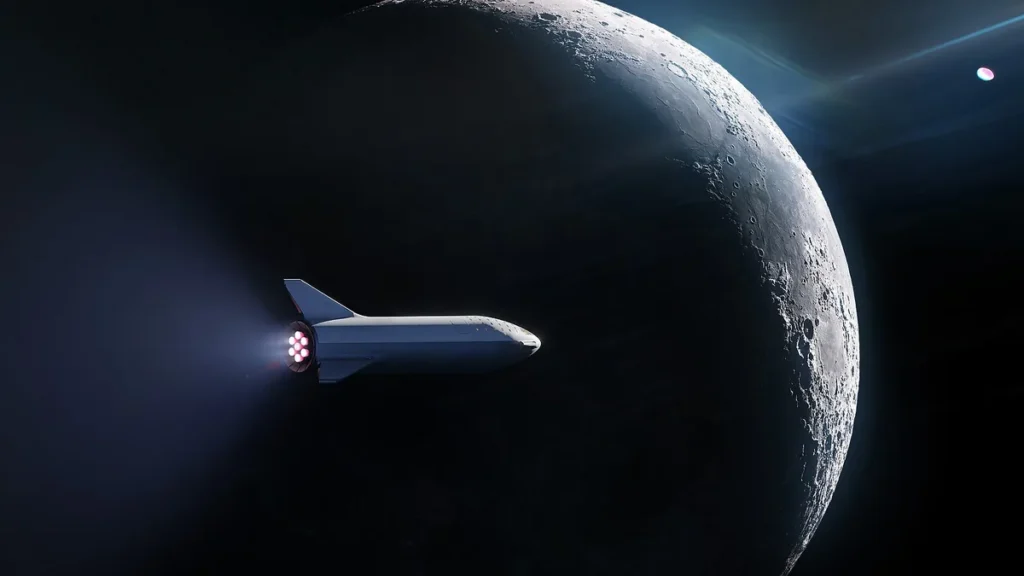
Imagine you’re an astronaut stranded 200,000 miles from Earth. Your ship’s oxygen tanks explode, disabling electrical and water capabilities. You were supposed to be on the third manned mission to the moon, but now you’re stuck in a desperate struggle to find a safe route home. Failure would mean certain death. The crucial tool for your rescue? Calculus. That’s not just a hypothetical; the situation was very real: it was exactly what the Apollo 13 astronauts faced. Calculus was crucial not just in Apollo 13 but in all of spaceflight, bringing the first men to the Moon, saving the crew of Apollo 13, and beating the Soviets in the space race.
At the start of the 1960s, the U.S. was far behind in the space race. The Soviet Union had beaten us to almost every major accomplishment: the first satellite (Sputnik), the first living creature (Laika), and the first man in space (Yuri Gagarin). Determined not to fall behind, in 1961, President John F. Kennedy launched the Apollo Program, committing the U.S. to landing a man on the moon by 1970. Through this program, the tables were turned. The U.S. burst into the lead, sending the first manned mission around the moon with Apollo 8. Then came the biggest achievement: on July 20th, 1969, Apollo 11 landed the first men on the moon. Five more manned missions were sent in Apollo 12, 14, 15, 16, and 17, while the Soviet Union failed even to send one. To this day, the U.S. is still the only country to have sent humans to the moon. Behind this success were countless hours of calculus and mathematical calculations.
So how did math actually get us to the moon? Mostly, calculus was used in designing trajectories and planning maneuvers. Attempting to navigate space without a carefully calculated trajectory would have been a death sentence. Before every launch, engineers had to chart a full course by calculating the spacecraft’s position and velocity over time. The key to this was calculus, specifically differential equations. Designing a trajectory required solving differential equations that linked force, acceleration, and velocity to describe changes in position over time. Integrals were used to calculate how the position would change due to velocity and acceleration, ensuring the spacecraft would land at the right place and speed. One basic integral engineers used to calculate how far a spacecraft would travel under constant acceleration was $\int_{0}^{T} a \, dt = aT$ , where $a$ is acceleration, and $T$ is time, giving them the velocity gained over that period.
It might sound simple at first, but it really wasn’t. Far from just plugging in numbers, constantly changing factors like the Earth’s, Sun’s, and Moon’s gravity, rocket engine thrust, fuel burn, and orbital drift all had to be considered. Engineers had to be absolutely sure of where and how fast a spacecraft would be. When calculating the return route for Apollo 13, even a small error in velocity could have caused the spacecraft to bounce off the atmosphere, missing the Earth entirely, meaning even the smallest mistake might have led to disaster.
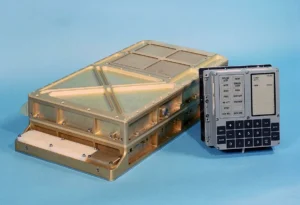
The Apollo Guidance Computer
The Apollo missions had computers, namely the Apollo Guidance Computer (AGC), but it wasn’t what you might imagine. Even a modern TI-84 calculator is over 350 times faster and holds 32 times the memory of the AGC. Of course, you could never run a spaceship off a TI-84. So what made the AGC so special? It was the fact that it was designed with one mission in mind: to do the math necessary for space flight. Using real-time data from the accelerometer and gyroscope, the AGC performed periodic numerical integration to estimate position and velocity. One method used was Euler’s method (a way to approximate integrals), essentially plotting a route by estimating position at many discrete points and connecting them. Using these estimates, the AGC would steer the spacecraft, generate thrust, issue mid-course corrections, and control the spacecraft during lunar descent. Thanks to the AGC, astronauts could safely navigate space, traveling to the moon and back.
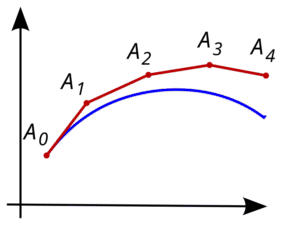
Basic visualization of Euler’s method
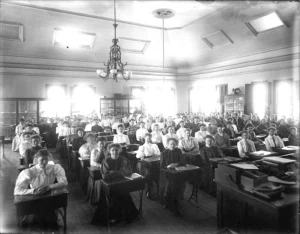
Machines weren’t the only ones doing the calculus. Long before liftoff, teams of women known as “human computers” were doing the math by hand. The AGC was useful, but it couldn’t do everything; pen and paper calculations were still required. Differentials and integrals all had to be hand calculated when plotting proper routes and determining the launch time. For example, human calculators would have needed to solve differential equations like $\frac{dv}{dt} = -g$ to compute how gravity would slow or accelerate a spacecraft depending on its altitude and path.
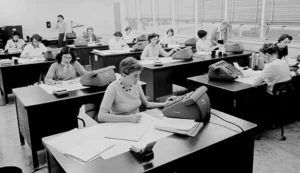
Human Computers at work
So, how exactly did Apollo 13 make it back against all odds? The credit goes to human computers. Whenever things went wrong, they were the ones who saved the day. In Apollo 13, NASA engineers had to manually calculate a safe return path. It was a race against time under immense pressure: calculations had to be completed before the astronauts ran out of oxygen, while remaining accurate. This life-or-death calculus was what made the plan that got the astronauts back.
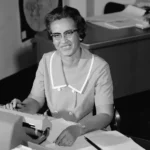
The most famous of the human computers was Katherine Johnson. She helped hand-calculate the trajectory for Apollo 11, the mission that brought the first men to the moon, and was one of the heroes who did the calculations that brought back Apollo 13. Even after the advent of computers fast and powerful enough to do the work, she was still trusted with manually calculating and verifying the paths of many NASA missions. If you’re interested in her story, you could watch the movie Hidden Figures. Though many details were altered for dramatization, it gives you an interesting glimpse into her life and the important work she did.
The Apollo missions were not accomplished through technology and bravery alone; mathematics — especially calculus — was an indispensable tool. The Apollo program was an incredible success, but none of it would have happened without calculus. Though the role of new technology was also critical, the lesser-mentioned importance of calculus in every aspect of the Apollo missions should not be forgotten. Next time you’re doing a derivative or solving a velocity problem, remember: this was the math that brought us to the moon.