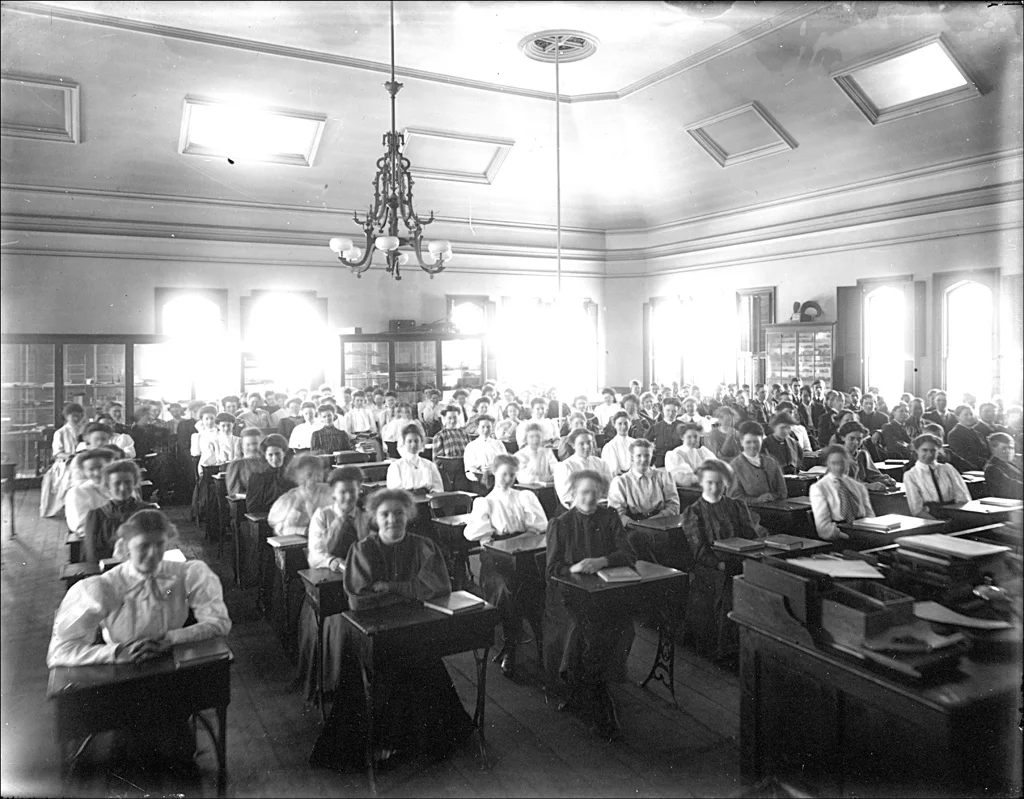
Imagine walking into a high school classroom in the early 1900s. Rows of wooden desks face the front of the room, where your teacher stands, lecturing while writing on a chalkboard. You don’t have a phone or a calculator, and even the ballpoint pen isn’t common yet. It’s just you and your ability to think and calculate by hand. So, how well would you have done in high school math a hundred years ago? The answer isn’t as obvious as it sounds. High school math in the 1900s was quite different in its goals, who took it, and even in the methods you’d be learning.
An important difference between then and now is who actually went to high school. Unlike now, when high school is mandatory across the country, and a high school diploma is a basic prerequisite for the vast majority of jobs, in 1900, only 10.6% of 14-17 year olds were enrolled in high school. The high school movement, which would eventually revamp high school education and enrollment, making attending high school feel “normal”, was just getting started and wouldn’t fully take off for another few decades. A 10.6% enrollment might seem strange for us, but it actually made a lot of sense in context. In 1870, only about 10% of the labor force had required education beyond elementary school, and that had only risen to 25% by 1925, meaning that for most, a high school education wasn’t necessary.
Even among students who did go to high school, many didn’t take advanced math. Less than 50% of high school students took Algebra, something that you probably took in freshman year or maybe even in middle school. Geometry and Advanced Algebra (Algebra II today) were even rarer. Calculus wouldn’t even begin to appear in high school curricula until the 1950s.
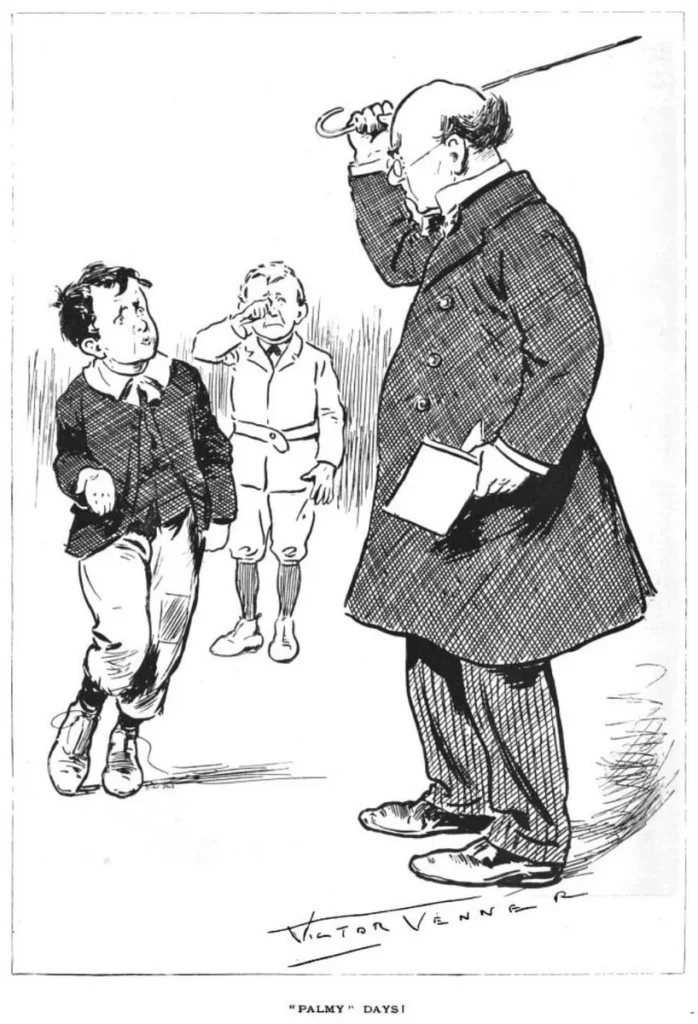
“Palmy Days” — a cartoon depicting corporal punishment in early 1900s schools, by Victor Venner
The classroom environment was much stricter. Discipline and obedience were strongly emphasized, and corporal punishment was still widely accepted. While they were beginning to fall out of favor, humiliating punishments, like wearing a dunce cap, were still used in many schools. Lessons usually revolved around the teacher and the chalkboard, with common ideas today, like project-based learning, not becoming prominent until the end of the century.
Testing was also much more stressful. As class sizes increased, oral examinations were gradually phased out in favor of written tests, but they remained much more common than they are now. Even when you didn’t have to face the pressure of an oral exam from your teacher, in some schools, everyone’s grades would be posted publicly as an incentive to do better work, a practice that certainly wouldn’t be allowed today. If you’re someone who loves multiple-choice tests, you’d also be out of luck, since almost all tests would be written responses similar to today’s short response questions. Multiple-choice tests wouldn’t really exist as a concept until at least 1915 and wouldn’t become common until the 1930s.
One positive, however, would have been the homework load. Starting in 1900, with the article “A National Crime at the Feet of Parents” in the incredibly popular Ladies Home Journal, an anti-homework campaign was spreading across the nation. In 1901, California banned homework for students under 15, also placing restrictions on the amount of homework that could be assigned to high schoolers. While it varied by region and school, it’s quite likely that your homework load as a high schooler in the early 1900s would be much lower than what you get now.
Assuming you were one of the few who made it to high school, what math would you have learned there? The early 1900s were a formative period for American math education, and the sequence of math courses we commonly see today was just starting to take shape. In 1893, a group of educators released the influential Report of the Committee of Ten, which aimed to standardize high school education across the country. This report helped establish the Algebra → Geometry → Advanced Algebra/Algebra II sequence that we still see in high schools today. The College Entrance Examination Board (now known as the College Board) was also founded in this period, in 1900, setting out standards for what students were expected to learn to be ready for college. Its influence could be seen in the textbooks of the era, with books like Advanced Algebra by Arthur Schultze (1906) making specific references to the College Board and the subjects required for its tests.
Education had two main goals: it prepared elite students for college, and it also emphasized more practical problem-solving, with some books having chapters or problems related to currency exchange, insurance, taxes, and the business applications of math. Below is a page from David Eugene Smith’s Practical Arithmetic, which was used by some schools in the early years of high school.
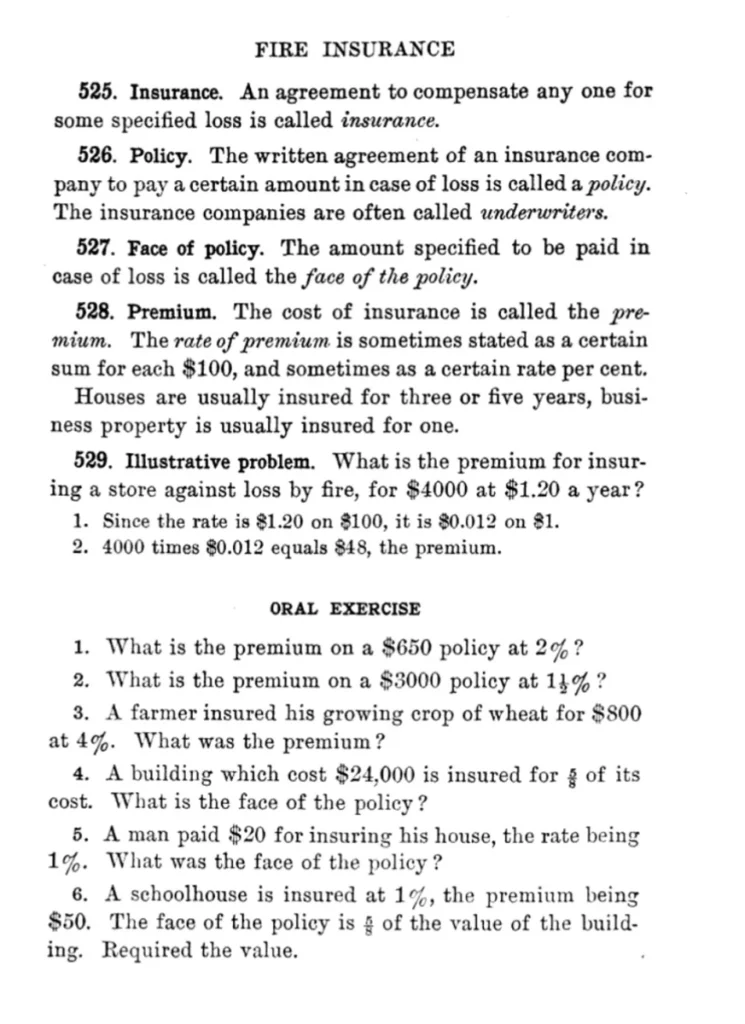
Page from David Eugene Smith’s Practical Arithmetic showing real-world insurance problems
Because calculators didn’t exist yet, computation played a central role. Students spent much more time than they do now mastering arithmetic, algebraic manipulation, and accuracy. Memorization and repetition were the standard, and the curriculum was rigid and standardized. Some more progressive educators had begun advocating for more hands-on mathematics, and while these ideas would prove influential later on, they were very much in the minority in their era.
One of the biggest differences was the lack of calculators. Modern math education doesn’t focus nearly as much on long or difficult calculations as it used to, because the ability to do a long calculation is much less useful than a solid understanding of the concepts, now that anyone could use a calculator to do the calculations much faster. Back then, it was the other way around. Accuracy, speed, and reliability were much more important, since manual calculations were both practical and necessary. Even after early mechanical calculators were invented, manual calculations by “human calculators” were crucial even up to the Space Race in the 1960s.
The lack of calculators also meant some other interesting differences in how concepts were taught. Logarithms are the best example. Ever heard of a characteristic and mantissa, or had to look through a log table? Probably not. Whenever you need to find a log, like log(0.28), for example, you likely reach for your calculator without a second thought. That wasn’t an option for students in the early 1900s. Instead, they had to learn a system where they’d first find the characteristic (non-decimal part) of a logarithm using a set of rules, before finding the mantissa using a five-place table of logarithms. Below are textbook pages showing all the rules you would’ve needed to memorize to find the value of a logarithm and a few sample problems.
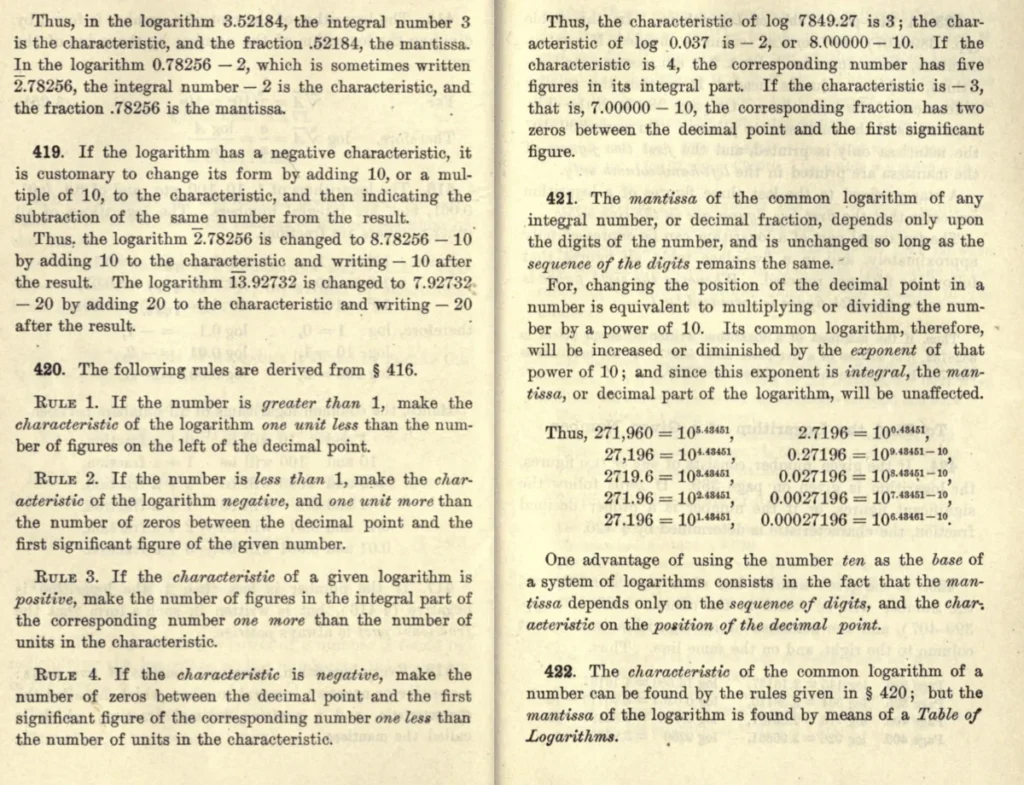
Rules for finding logarithms from an early 1900s textbook, including characteristic and mantissa
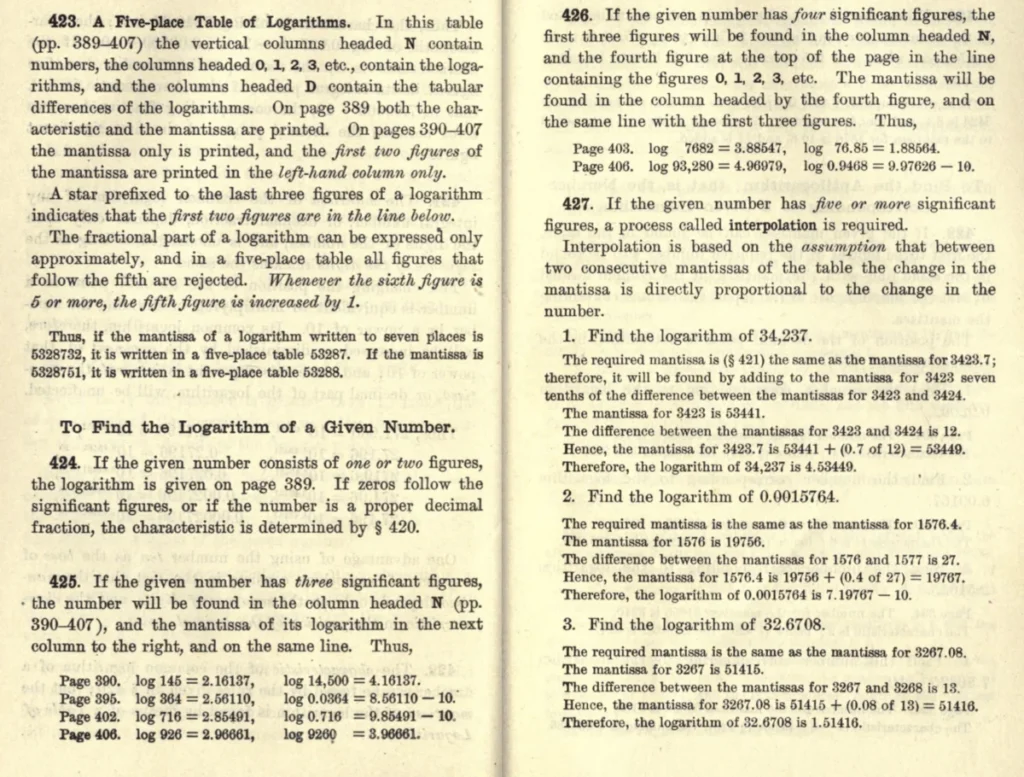
Sample logarithm problems and table usage from an early 1900s textbook
Alongside log tables, students were also trained to use slide rules, devices that helped perform complex operations like multiplication, division, roots, and trigonometry, using logarithmic scales. These were mechanical calculators that made difficult calculations much faster and more accurate. These, along with log tables, were essential tools for math, science, and engineering, with slide rules still being heavily used for calculations in the Apollo missions. Determinants were also emphasized much more heavily than they are now. Matrix methods weren’t yet standard in the early 1900s, so determinants were the primary method used to solve systems of equations.
Geometry was also quite different, being much more formal, focusing almost solely on proofs and meticulously drawn diagrams using compasses and rulers. Some subjects, like Statistics, didn’t exist at all in high schools, with almost no statistics being taught and no classes being even remotely similar to classes like AP Statistics today. As mentioned earlier, Calculus also wasn’t part of the high school curriculum, even in elite college preparatory tracks.
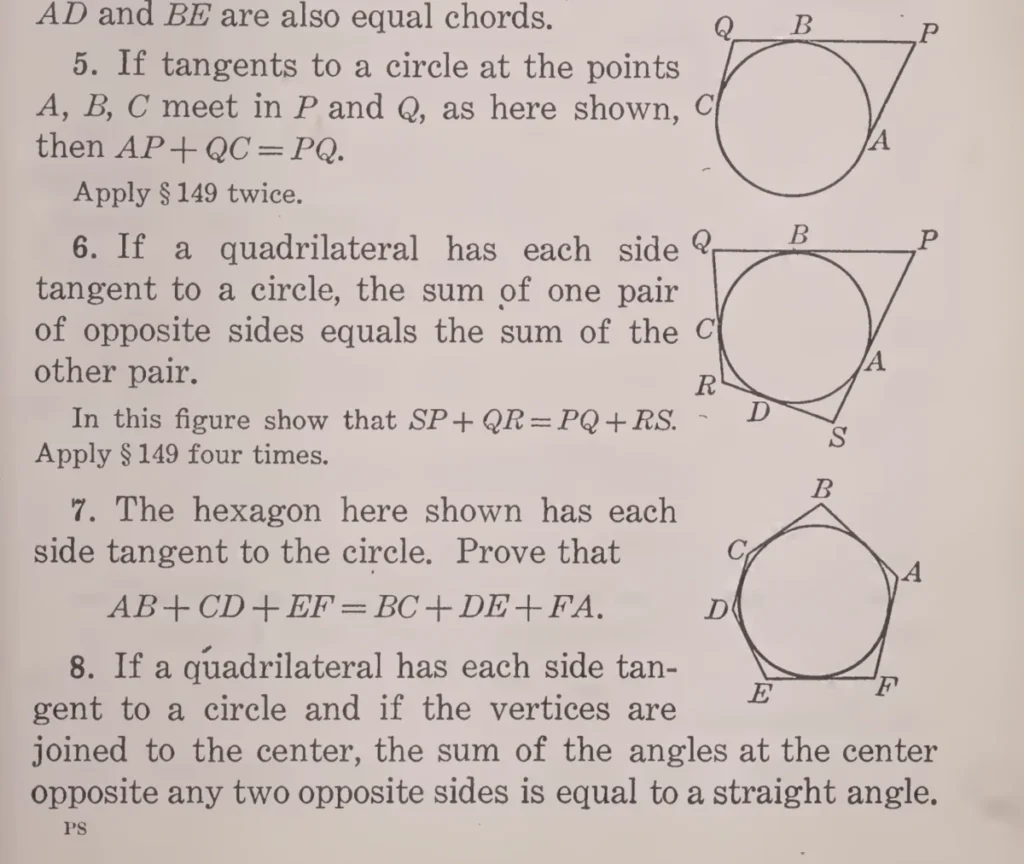
Problems from Essentials of Plane and Solid Geometry by David Eugene Smith (1923)
Generally, though, the specific topics you would have studied would be pretty familiar. None of the chapter names in textbooks like New School Algebra by George Albert Wentworth (1898), like “Fractional Equations”, “Problems with Two or More Unknown Numbers”, “Imaginary Expressions”, “Quadratic Equations”, “Binomial Theorem”, or “Logarithms” would seem too strange or out of place in a modern textbook. The main difference was in how it was taught: with much more focus on memorization, repetition, and manual calculations using tools like log tables and slide rules, which were once crucial but are now obsolete.
So, would you have survived high school math in the early 1900s? It would have required much more manual skill, endurance, and precision than modern math education demands, and you would have had to handle a much stricter environment. You would have needed to be comfortable with lots of repetition and be able to do long calculations that would seem tedious and unnecessary today. You’d also have to learn some skills that have now become obsolete, like using a log table and a slide rule, and all the rules that come with those, which might feel quite difficult at first. Beyond that, the concepts covered and level of difficulty, even in the college preparatory tracks, generally weren’t much harder than what you’d see in high schools today, and the average high schooler learns much more than the average person did back in the day, where the vast majority of people never even learned Algebra. If you’re curious whether you could’ve handled math from a college prep track, check out the assignment attached, where you’ll find a selection of interesting problems from real textbooks that were published in the early 1900s.
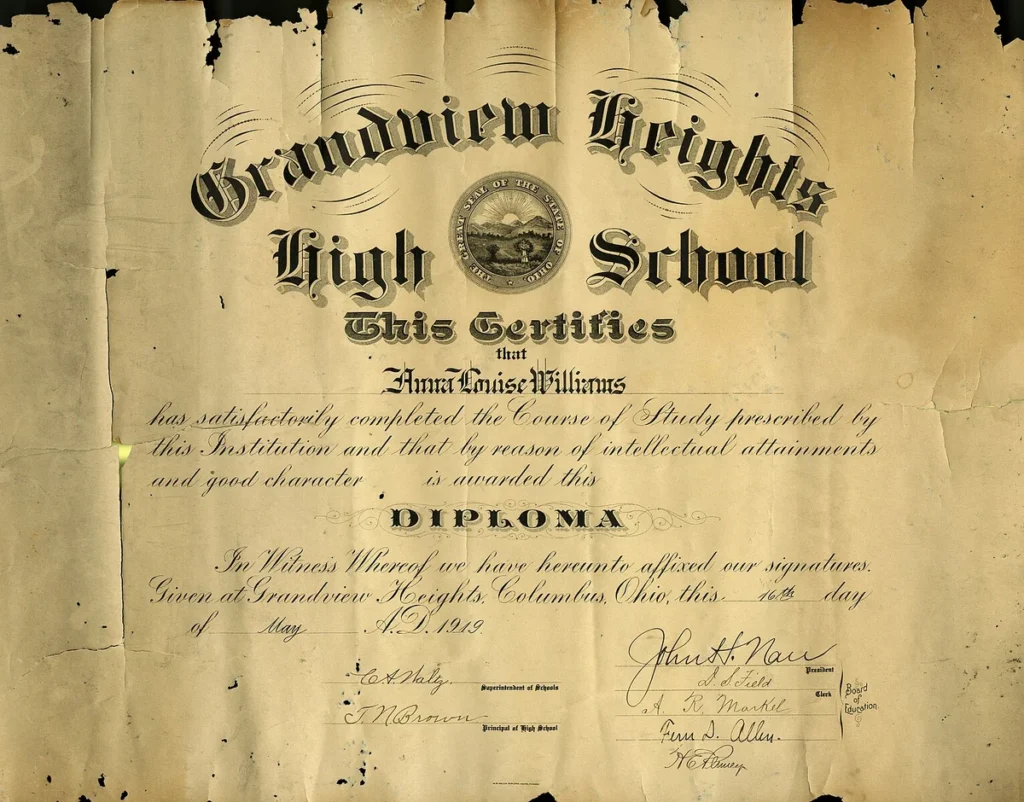
High School Diploma from Grandview Heights High School, Columbus, Ohio (1919)