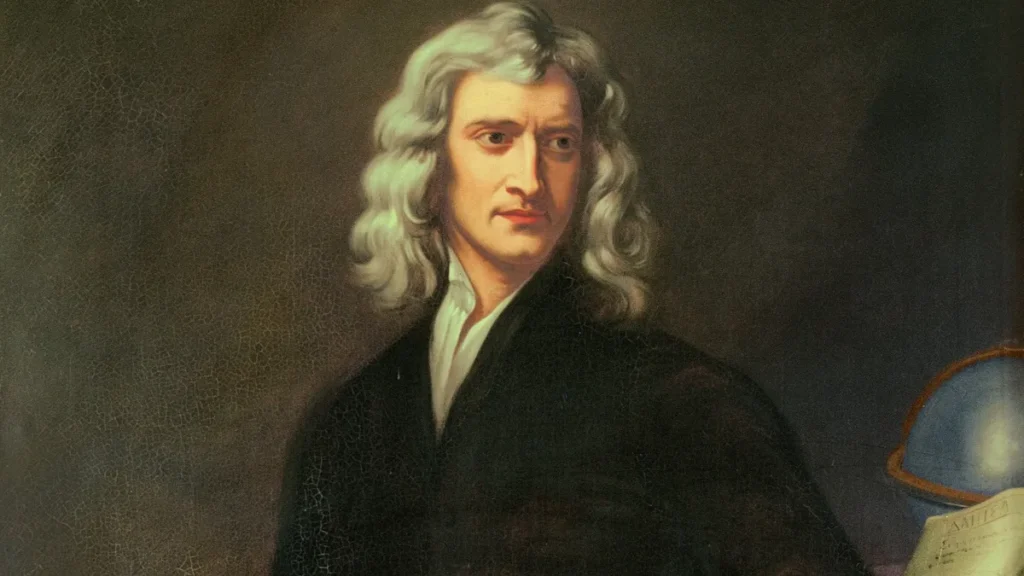
Isaac Newton: the man who explained gravity, invented calculus, and revolutionized physics. You might imagine him as a lone genius, but in reality, he relied on mentors just as much as we do, admitting, “If I have seen further, it is by standing on the shoulders of giants.” These ‘giants’ weren’t abstract predecessors; they were real people whose ideas and guidance shaped Newton into a polymath who transformed mathematics and physics. Most direct was Isaac Barrow, Newton’s teacher at Cambridge, who inspired his development of calculus and handed him the position that secured his career. Less direct but just as important were John Wallis, whose work on infinite series inspired Newton’s binomial theorem, and René Descartes, who was often criticized by Newton but gave him a framework to think about motion and space. Newton may have been a prodigy, but his work wouldn’t have been possible without inspiration from his predecessors.
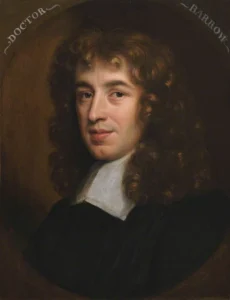
Isaac Barrow
If Newton had a true mentor, it was Isaac Barrow. A talented mathematician and the first Lucasian Professor of Mathematics at Cambridge, Barrow quickly recognized Newton’s talent. He nurtured Newton’s growth through private discussions after lectures, urging him to push beyond the standard mathematics curriculum.
Even Barrow was often shocked by Newton’s incredible work. In 1668, Barrow received a new book by Mercator about infinite series, one widely praised for its novel methods, and passed it along to Newton. After skimming it, Newton realized it overlapped with work he had already done, rushing home to find his own manuscripts. When he returned, he handed Barrow his own work, shocking him with discoveries that went well beyond Mercator’s. This cemented Newton in Barrow’s eyes as someone truly exceptional: a mathematician whose discoveries had already gone beyond the latest European work.
In 1669, Barrow made a remarkable move, resigning his prestigious chair and recommending Newton as his successor. Though it’s believed Barrow had his own motives, becoming a royal chaplain after giving up his professorship, his recommendation of Newton was still a sign of his great confidence in him. Imagine if your teacher held one of the most important positions in the country, and they believed in you so much that they gave it to you. Barrow’s gift was just as unimaginable back then as it is now. This gift gave Newton the platform, financial stability, and intellectual freedom to continue working on his ideas. Barrow’s own research also inspired Newton’s future work. His Lectiones Geometricae contained important insights into tangents and a geometric proof of the Fundamental Theorem of Calculus, which Newton would build off of in developing his own calculus. Without Barrow, Newton may never have had the chance or the inspiration to show his genius.
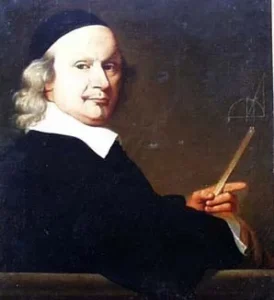
John Wallis
John Wallis certainly wasn’t a mentor in the traditional sense: he wasn’t Newton’s professor, and might not have even met him in person, but he was still incredibly influential. His work in the Arithmetica Infinitorum introduced systematic methods for handling infinite series to find areas under curves, a crucial step in the development of integral calculus. Newton studied this work as a student, and it was the inspiration for his development of the generalized binomial theorem and his method of fluxions that would be used in his calculus. It was based on Wallis’ ideas that Newton produced his work that shocked Barrow in 1668, one year before Barrow gave up his professorship for Newton.
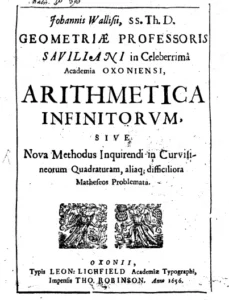
Beyond being an inspiration, Wallis was also a powerful ally. He was in close correspondence with Newton, first helping to edit his work and circulate his early papers, and later defending him in the dispute with Leibniz over who developed calculus first. Wallis leveraged his standing in the English scientific community to defend Newton, even publishing Newton’s earlier manuscripts to strengthen his claim to priority. Even without formal mentorship, Wallis played a key role as an indirect mentor, giving Newton both the inspiration and the defense he needed to establish himself.
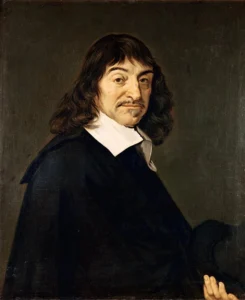
René Descartes
René Descartes never spoke to Newton; in fact, he never even knew Newton existed. He died when Newton was only seven years old, long before Newton did anything of note, but his ideas were still key to Newton’s education. His La Géométrie unified algebra and geometry into the single framework of analytic geometry, one Newton would use to describe motion and space and incorporate into his calculus. Descartes’ emphasis on precision, clear reasoning, and his mechanical philosophy also shaped Newton’s view of the world.
Despite his influence, Newton often disagreed with Descartes’ work, critiquing his theory of motion and ultimately providing a better alternative to Descartes’ Cartesian Physics. In fact, it’s said that Newton, in all his writings, “has never mentioned Descartes favorably; and, on more than one occasion, treated him with injustice.” Despite this, however, Descartes still played an important role, with his mechanistic framework for physics and analytic geometry serving as important starting points for Newton’s work, even if he often found issues with Descartes’ other ideas. Going against Descartes’ ideas, especially those of Cartesian Physics, also helped Newton in creating his own.
A quick Google search will show that Benjamin Pulleyn was Newton’s official college tutor at Cambridge, so you might expect to see him on the list of mentors. After all, how could you not include the person who was officially Newton’s mentor? In reality, though, Pulleyn had little to no influence on Newton’s work, being a classical scholar who lacked the expertise to help Newton in science or math. In fact, Pulleyn was known as a “pupil monger” who accepted additional students solely to increase his own income. Though Pulleyn might officially have been Newton’s mentor, he can’t really be considered a true mentor in the sense of inspiring Newton or helping to develop his career.
Newton may be remembered as a scientific and mathematical genius, but his brilliant work was supported and enabled by those who came before him. Whether directly or indirectly, Barrow, Wallis, and Descartes all provided mentorship and inspiration for Newton, contributing to the foundations of his work on calculus and physics. Newton himself knew this: he stood on the shoulders of giants, and saw further than ever before.