This is Part I of our two-article series on the History of Calculus
Calculus is a superpower in math. From predicting planetary orbits to optimizing internet speeds, it’s been a cornerstone of countless advancements. But who invented this power tool? Actually, it took the collective genius of many mathematicians over millennia to develop the calculus we know today.
Imagine trying to figure out the area of a circle by filling it with shapes that approximate it. If you use a triangle, there are some big gaps, but if you use a square, then a regular hexagon, then a regular octagon, those gaps start to shrink, and the areas of the two shapes get closer. Eudoxus used this technique, known as the method of exhaustion, to find the areas of circles, solids, and spheres. This is the first known example of the idea of a limit.
Fast forward 100 years, and we meet Archimedes. He built upon Eudoxus’s work and began exploring methods for calculating tangent lines to shapes other than circles. Using polar coordinates, he was able to calculate the slope of a line tangent to an Archimedes’ spiral given by the polar equation $r = a\theta$, where $a$ is a constant. Archimedes was the first mathematician to do so. Nowadays, these computations would be done using derivatives, but because they had not yet been invented, Archimedes had to use more primitive tools, viewing the spiral as a series of line segments and seeing what happened as the line segments got shorter, essentially using a limit. Archimedes was a trailblazer, paving the way for future developments.
Between the Ancient Greeks and the Renaissance in Europe, developments in calculus were slow. Mathematicians in the Middle East, the math powerhouse at the time, mainly focused on algebra and geometry, making huge developments in those fields, but did not concern themselves with calculus. The next big name in calculus was Nicole Oresme, a French philosopher who contributed to economics, physics, astronomy, theology, and mathematics.
Around the mid-3rd century AD, in the other part of the world, the Chinese mathematician Liu Hui came up with his own version of the “method of exhaustion,” independently of Eudoxus. Other developments came later from the Middle East and India, in the 11th and 14th centuries, respectively, but the study of calculus was a slow march that did not capture the world’s attention. In the 14th century, all of that changed.
Born in 1325, Oresme was one of the only significant European mathematicians for centuries. The inventor of the “+” sign, he was the first to graph quantities, foreshadowing Descartes’ coordinate plane, and showed that the Harmonic Series $1+\dfrac{1}{2}+\dfrac{1}{3}+\dfrac{1}{4}+\dots$ diverges in the following way:
$$\dfrac{1}{2} = \dfrac{1}{2}$$
$$\dfrac{1}{3} + \dfrac{1}{4} > \dfrac{1}{4} \cdot 2 = \dfrac{1}{2}$$
$$\dfrac{1}{5} + \dfrac{1}{6} + \dfrac{1}{7} + \dfrac{1}{8} > \dfrac{1}{8} \cdot 4 = \dfrac{1}{2}$$
And so on, grouping fractions in sets of 1, 2, 4, 8, and so on to prove that $\dfrac{1}{2} + \dfrac{1}{3} + \dfrac{1}{4} + \dots > \dfrac{1}{2} + \dfrac{1}{2} + \dfrac{1}{2} + \dots = +\infty$.
Additionally, he stated a version of the fundamental theorem of calculus, stating that the area underneath a velocity-time graph was equal to the distance traveled. Because velocity is the time derivative of position, he was essentially saying that
$$\int_a^b f^{\prime}(t)\, dt = f(b)-f(a)$$
However, he did not generalize this to any function, so he is not credited with the discovery of the FTC. Still, he was extremely important to the eventual discovery of calculus.
Madhava was an Indian mathematician who lived in the 14th and early 15th centuries (the exact dates are unknown). He pioneered trigonometry and infinite series long before they were independently discovered in Europe. While there is no evidence that his ideas were transmitted to Europe (and thus the creators of calculus as we know it), he is still worth mentioning.
Madhava studied infinite series, including the power series for the inverse tangent, which he wrote as
$$\theta = \tan\theta-\dfrac{\tan^{3}\theta}{3} + \dfrac{\tan^{5}\theta}{5}-\dfrac{\tan^{7}\theta}{7} + \cdots$$
On this note, he made contributions to trigonometry and constructed sine and cosine tables accurate to 7 decimal places! He also approximated $\pi$ to 12 decimal places by using the infinite series.
Pierre de Fermat (1607-1665) is one of the best-known mathematicians ever due to his Last Theorem, Little Theorem, and Fermat primes, as well as making fundamental discoveries in probability, optics, and analytic geometry, a precursor to calculus. Fermat discovered a method of finding tangents to curves.
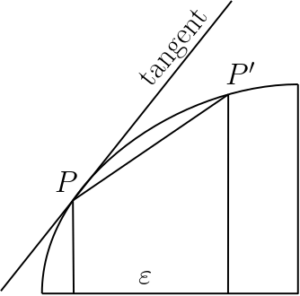
This method involves drawing a line between a point $P$ and another point $P^{\prime}$ on the curve, and then letting $P^{\prime}$ get closer and closer to $P$, so that $\varepsilon$ gets closer and closer to $0$ and the line $\overline{PP^{\prime}}$ approximates the tangent line $PT$ better and better. The formula to find the slope of the tangent line can then be given by $m = \displaystyle \lim_{\varepsilon\to0} \dfrac{f(x + \varepsilon)-f(x)}{\varepsilon}$, which you may recognize as the formula for a derivative. Fermat also noticed that the sum under a curve given by $f(x) = x^n$ was equal to $nx^{n-1}$, which is equivalent to the power rule for integration. However, it is not known whether he figured out that differentiation and integration were inverses of each other, which is one reason why, like Oresme, he is not credited with the invention of FTC.
In 1615, German mathematician Johannes Kepler published a groundbreaking work that laid the foundation for integral calculus. His interest was sparked when a merchant who was selling him wine used an inconsistent method to calculate how much wine was in each barrel. Kepler thought that there must have been a better way, and so he set out to study volumes and areas. Through his studies, he derived a rule that served as an approximation of integrals similar to Riemann sums. Here is the rule he discovered for approximating definite integrals, also known as Simpson’s Rule:
$$\int_a^b f(x)\, dx \approx \frac{b-a}{6}\left[f(a)+4f\left(\frac{a+b}{2}\right)+f(b)\right]$$
Kepler was a major figure during the Scientific Revolution, which saw huge leaps in our understanding of the world. Apart from mathematics, his work in astronomy – especially his laws of planetary motion – inspired a young man named Isaac Newton.
Later in the 17th century, calculus was formally developed by Newton and Leibniz, who independently laid the foundations of modern calculus. To learn more about them and later developments that created the modern calculus we use today, check out Part II of this article!