This is Part II of our two-article series on the History of Calculus
After centuries of advancements starting from Ancient Greece, the foundations of calculus were finally laid by Newton and Leibniz. To learn more about these earlier advancements, check out Part 1 of this article! This article explores the development of modern calculus, from Newton and Leibniz to the modern day.
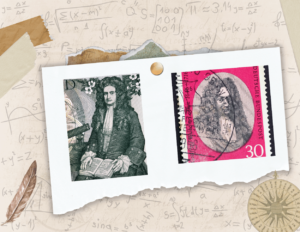
Newton, famous for his work in physics and the story of the falling apple, is one of the key figures in the development of calculus. Newton was not limited in his studies and made great developments in calculus and physics, as the two disciplines were inextricably linked. As the story goes, Newton sat under a tree one day, taking a nap, and was hit in the head by an apple. Where most people would walk away with nothing more than a bump on their head, Newton walked away with the beginnings of a major scientific realization: all objects obey the rule of universal gravitation. While this story is more based in folklore than reality, and it is likely that he merely witnessed an apple falling, his breakthrough itself is historically factual. Following this incident, Newton developed the core principles of Newtonian Mechanics. In 1948, the unit of force called the “Newton” was officially adopted in his honor. However, Newton was faced with a big obstacle – the mathematics necessary to describe the science of motion had not yet been developed. Newton found an elegant solution to this problem – he developed the mathematics himself! He called his theory “fluxional calculus,” which was very effective in describing motion. During the 1660s and 1670s, Newton made significant advancements, but he wasn’t alone in his discoveries.
Isaac Newton, famous for revolutionizing physics and calculus, is generally credited with inventing calculus, along with Gottfried Leibniz. While the story about an apple falling on Newton’s head is likely apocryphal, it is likely that a falling apple did inspire his law of universal gravitation, building on Galileo’s earlier work. Upon delving deeper into physics, he wanted a way to describe the motion of large objects, such as planetary motion; one of his biggest breakthroughs was using calculus to prove that the orbits of the planets were ellipses, which agreed perfectly with Tycho Brahe’s measurements of planetary motion from the Uraniborg observatory. Newton mainly saw calculus as a way to describe motion, and the notation for his “fluxional calculus” could differentiate or integrate with respect to time. He was most productive during the 1660s and 1670s but did not publish his work until 1687, leading to one of the greatest mathematical feuds of all time.
Have you ever thought you had a brilliant idea, only to find out someone else had it too? That’s exactly what happened with Newton and his German contemporary, Gottfried Leibniz. Both discovered key aspects of calculus around the same time.
Newton focused on differential calculus, coming up with the concept of the derivative as a way to describe change, although he was, with his. His big breakthroughs happened during the 1665-66 London plague when he was isolated on a farm, where the story of the falling apple allegedly took place. Some researchers have called this his annus mirabilis, or miraculous year, in which he uncovered laws of gravity, optics, motion, and calculus.
Leibniz’s breakthroughs came several years later as the young German mathematician was convinced to study calculus by Dutch Mathematician Christiaan Huygens in 1672. Leibniz embarked on a fierce exploration of calculus in the following years, and soon he began to make headway. He reasoned that the slope of a line was a ratio of the change in the “ordinate” (y-coordinate) to the change in the “abscissa” (x-coordinate). He then reasoned that an integral was the sum of infinitely small ordinates across one abscissa, or a sum of all of the infinitely thin rectangles beneath a curve. This was one of Leibniz’s biggest breakthroughs, as he realized that the slope of a tangent and integral were inverse operations, which is the fundamental theorem of calculus. He knew his discoveries were special and took pains to create a notation to convey them.
Between October and November of 1675, Leibniz formalized his notation, creating much of the common calculus we use today, such as the large S-shaped integral sign and using ‘$dx$’ and ‘$dy$’ to describe the infinitely small ordinates and abscissas:
$$\displaystyle\int_a^bf(x)dx \qquad\frac{dy}{dx}$$
Both Leibniz and Newton made great contributions to the calculus we use today, but although Newton discovered calculus first, Leibniz published his work first, leading to a huge dispute between them.
As people recognized the profound significance of the discoveries made by Newton and Leibniz, one question persisted: who discovered calculus first? Initially, this question did not seem to matter. Both Newton and Leibniz had independently discovered the fundamental principles of calculus, and they appeared to respect each other’s achievements. Although they had some disagreements over the details and methods of calculus, they did not question each other’s integrity.
All that changed in 1695 when a British mathematician, John Wallis, started a fire he couldn’t put out: he accused Leibniz of plagiarizing Newton’s work! What ensued was a dirt-slinging insult battle with drama to rival a Shakespearean play.
Newton embarked on a smear campaign to silence Leibniz to make sure that he, and only he, would be remembered as the “father of calculus.” He spread rumors that Leibniz had some of his early calculus manuscripts and that he had written letters to Leibniz discussing these topics. When Leibniz’s friends tried to defend him, Newton turned up the heat and pressured them into taking back anything they said.
Soon the mathematical community lost its trust in Leibniz and hailed Newton as the true father of calculus. In 1713, the Royal Society, which Newton was the president of (talk about bias!), published an official paper proclaiming that Newton was the first in the calculus race and that Leibniz had been influenced by Newton.
Sadly, after taking punch after punch from Newton and his cronies, Leibniz died poor and dishonored without much to his name, but since then history has been kinder to him. Mathematicians eventually realized that Leibniz invented much more effective notation. It was widely adopted, and it is now used worldwide. Here is Newton’s notation for derivatives and integrals, with the dot notation referring to derivatives and the prime notation to integrals. Newton’s notation for integrals was inconsistent and unintuitive, which introduced significant difficulties:
$$\text{derivative: } \dot{y} \qquad \text{integral: } y^{\prime}, \boxed{\phantom{y}} y, \boxed{y}$$
Source: https://en.wikipedia.org/wiki/Notation_for_differentiation#Newton%27s_notation_for_integration
While Newton’s notation can be used and actually is used by physicists, Leibniz’s notation is more specific, as it identifies both the variable of integration and differentiation, and it emphasizes the ratio relationship between $dy$ and $dx$. In addition to this, Newton’s notation for integrals would be confusing, since it’s exactly the same as Joseph-Louis Lagrange’s derivative notation – Lagrange used the prime symbol to denote derivatives, while Newton used it to denote antiderivatives. This is why mathematicians use Leibniz notation for derivatives and integrals.
Historians now believe that Newton and Leibniz independently discovered calculus without any foul play. Still, due to the contentious circumstances of the debate, England clung to Newton’s more cumbersome notation for over 100 years, ignoring many mathematical advancements occurring in mainland Europe. As a result, they fell significantly behind in mathematics and the physical sciences. Morris Kline aptly described this situation in his book Mathematical Thought from Ancient to Modern Times Volume Two, stating, “The English settled down to study Newton instead of nature” (Kline, pg. 622). Instead of using Newton’s and Leibniz’s work as a springboard for new discoveries in mathematics and physics, as most of Europe did, they effectively isolated themselves from global mathematical developments, leading to over a century of stagnation. During this period, they produced only a few notable mathematicians and failed to make significant advances in math or science. It wasn’t until the British adopted more modern notation in the 1820s that they began to catch up with their international peers. England’s Unwavering devotion to Newton indeed contributed to its decline in scientific progress.
After the time of Newton and Leibniz, calculus underwent profound developments that continued to enrich its theory and applications. Augustin-Louis Cauchy rigorously defined limits, continuity, and derivatives in the 19th century, establishing a true foundation for calculus. Mathematicians like George Berkeley had expressed skepticism about infinitesimals and other shaky parts of calculus theory, but Cauchy’s work silenced him and other skeptics. Karl Weierstrass continued Cauchy’s work, formalizing the definition of a function. After the work of these two men, no one would successfully question the validity of the core tenets of calculus.
New innovations kept pouring in as Leonard Euler extended calculus to include functions of complex numbers and introduced the notation we use today, while Lagrange developed the method of Lagrangian mechanics, similar to Newtonian Mechanics except more focused on energy than on forces. These developments and so many more enabled calculus to flourish as a rigorous mathematical discipline in modern science.
You now know a lot more about the development of calculus, from its early beginnings to its development into the rigorous calculus we use today. The history of calculus is one of a collective effort by many brilliant minds who, over centuries, shaped this powerful tool.