Have you ever challenged someone else to solve a difficult math problem, either for fun or to try and prove your superiority? In the late 17th century, Johann Bernoulli did the same with the greatest mathematicians in Europe. Posed publicly in 1696 as a test of Europe’s brightest minds, the brachistochrone problem drew solutions from Newton, Leibniz, and the Bernoulli brothers, ultimately giving birth to an entirely new branch of math.
The problem itself is quite simple. Given two points A and B in a vertical plane, with B lower than A but not directly below it, find the curve along which an object, sliding without friction and pulled only by gravity, travels from A to B in the least time. The name “brachistochrone,” created by Johann Bernoulli himself, comes from the Greek words brachistos (shortest) and chronos (time), meaning “shortest time.”
Your first instinct might be to think of a straight line, but, as you might imagine, the problem is much more difficult than that. While a straight line is the shortest way to get from point A to point B, the problem also depends on speed. A steep drop at the start lets the object build up speed early, which can make up for the longer distance traveled. The ideal curve has to balance these two effects, being steep enough to gain speed quickly, but not so long that the added distance cancels out the benefit.
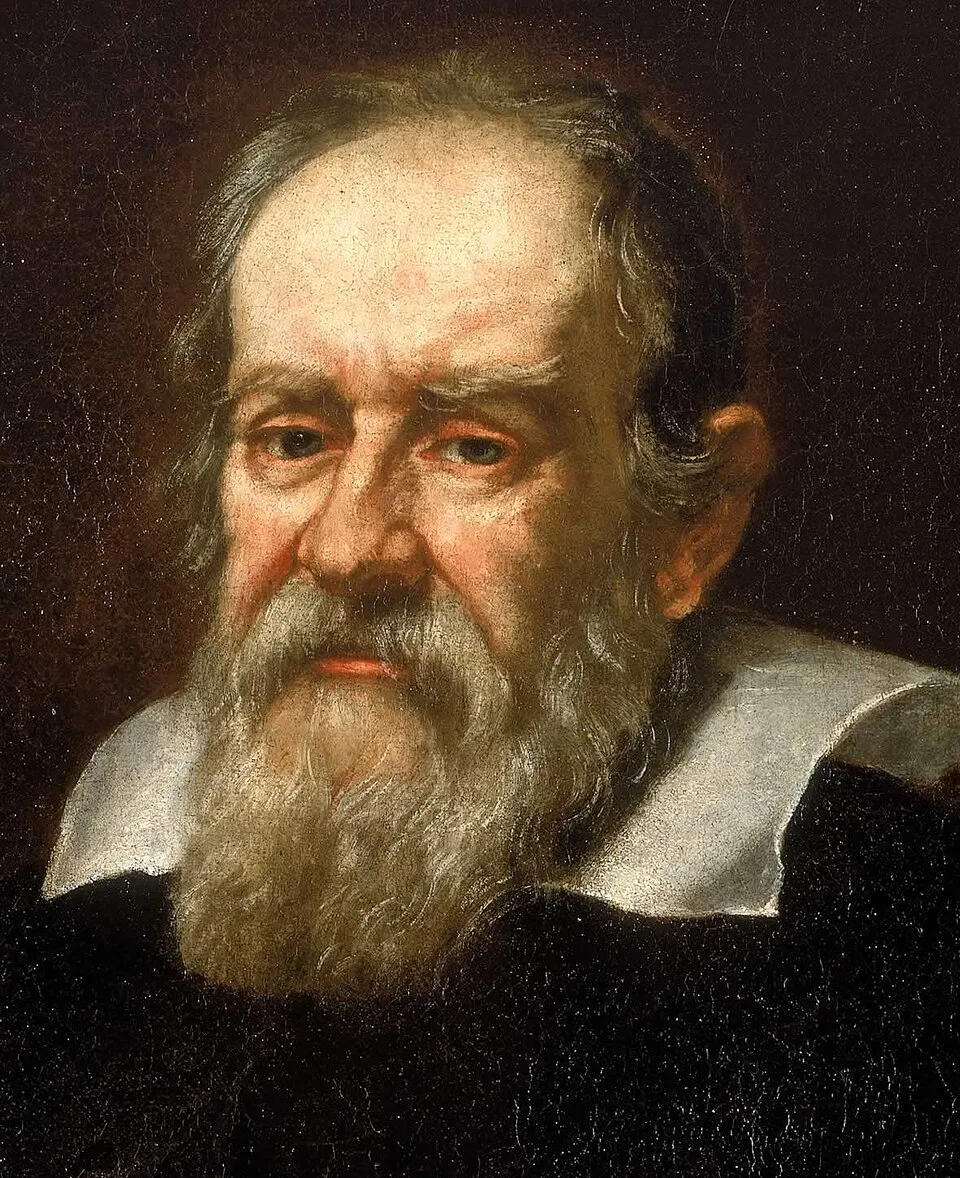
Galileo Galilei
The first major attempt at a similar problem came from Galileo. In his 1638 book Discourse on Two New Sciences, Galileo considered the fastest way for an object to descend from a point to a vertical line. He correctly realized that a straight line was not always the fastest, but limitations in the math of his time led him to the incorrect solution, with Galileo believing that the fastest path would be an arc of a circle.
The problem returned in June 1696, when Johann Bernoulli published it as an open challenge in the Acta Eruditorum, one of the leading scientific journals of the era. He addressed it to “the most brilliant mathematicians in the world,” writing that he hoped to “test their methods and the strength of their intellect.” Bernoulli originally allowed six months for responses, but was persuaded by Leibniz to extend the deadline so that mathematicians in other countries, particularly in England, would have time to participate.
The challenge wasn’t entirely friendly. Leibniz and the Bernoulli brothers were leaders of the continental school of calculus, and both Bernoulli brothers actively supported Leibniz in his priority dispute with Newton. In his challenge, Bernoulli referenced “mathematicians who boast that [they] have wonderfully extended [calculus’s] bounds by means of golden theorems which (they thought) were known to no one, but which in fact had long previously been published by others,” a clear jab at Newton. So, the challenge was, at least partially, a trap designed to test what Newton really knew and see if he truly knew as much calculus as his supporters claimed.
In the end, solutions only came from a very short list of people: Johann Bernoulli himself, his older brother Jacob, Leibniz, L’Hôpital, and Newton. All of them found the same answer: the cycloid.
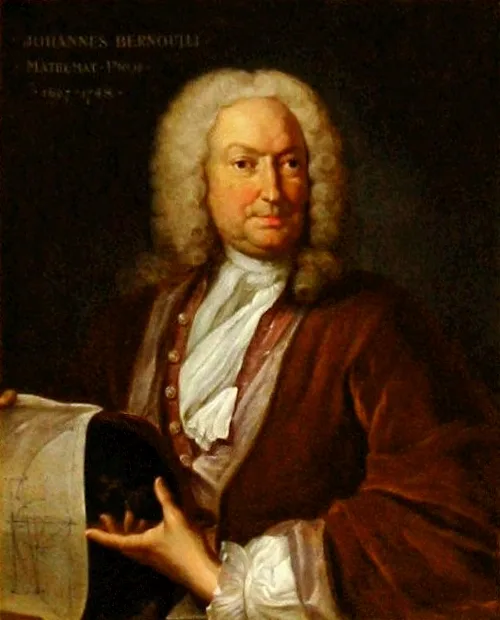
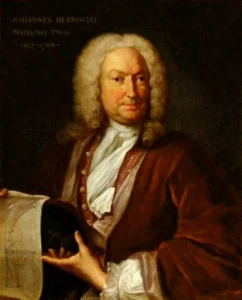
Johann Bernoulli
Johann Bernoulli’s solution relied on a connection between falling objects and the movement of light. According to Fermat’s principle, light follows the path that takes the least time. When light passes between materials in which it travels at different speeds, its path bends, producing refraction. Bernoulli imagined dividing the region below the starting point into many thin horizontal layers. The falling bead would move slower in the upper layers and faster in the lower ones, after it had picked up more speed. Bernoulli then treated the bead’s path like the path of a ray of light passing through the layers in which its speed continually increased. Using the mathematical law governing refraction and making the layers infinitely thin, he obtained a smooth curve. That curve was the cycloid.
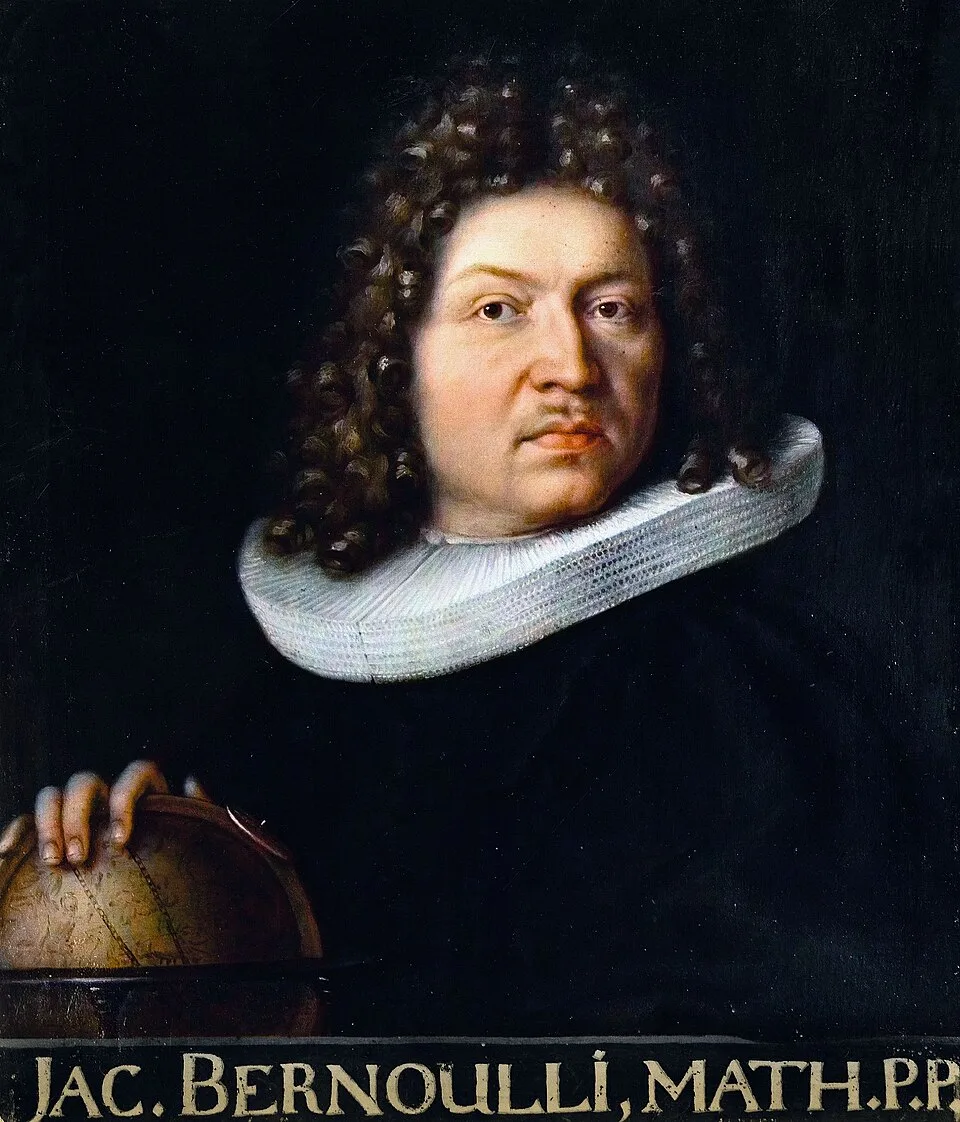
Jacob Bernoulli
Johann wasn’t the only Bernoulli to solve the challenge. His older brother Jacob Bernoulli found the same answer through an entirely different method. By comparing tiny portions of the curve and reasoning that every section of the fastest overall route must itself be locally fastest, Jacob derived a condition identifying the curve as a cycloid. While the brothers had originally studied calculus together, their relationship had become increasingly competitive over time. The brachistochrone became one of the most bitter disputes in their rivalry. Some accounts report that Johann’s original proof contained an error, and that after Jacob developed a correct derivation, Johann attempted to present his brother’s reasoning as his own. Others place greater emphasis on Johann’s separate optical argument, which connected the problem to Fermat’s principle and the refraction of light. Whether Johann actually stole Jacob’s reasoning or not, the brothers strongly disagreed over their methods and the credit for the solution.
Their conflict didn’t end with the original problem. In 1697, Jacob posed a more difficult variation involving the fastest cycloid from a starting point to a vertical line. He then challenged Johann with a series of related optimization problems. The dispute became increasingly hostile, but the methods used would help lay the foundation for what would become the calculus of variations, a new branch of mathematics concerned with finding functions or curves that maximize or minimize a quantity.
Leibniz and L’Hôpital also had their own ingenious solutions. Leibniz used differential calculus to minimize the travel time along a two-segment broken path, then extended the resulting condition to infinitesimal sections of the full curve to obtain the differential equation of a cycloid. L’Hôpital also looked at two-segment paths, but instead geometrically compared them with nearby alternatives, deriving a relationship between the path’s angle and the falling object’s speed that’s satisfied by a cycloid.
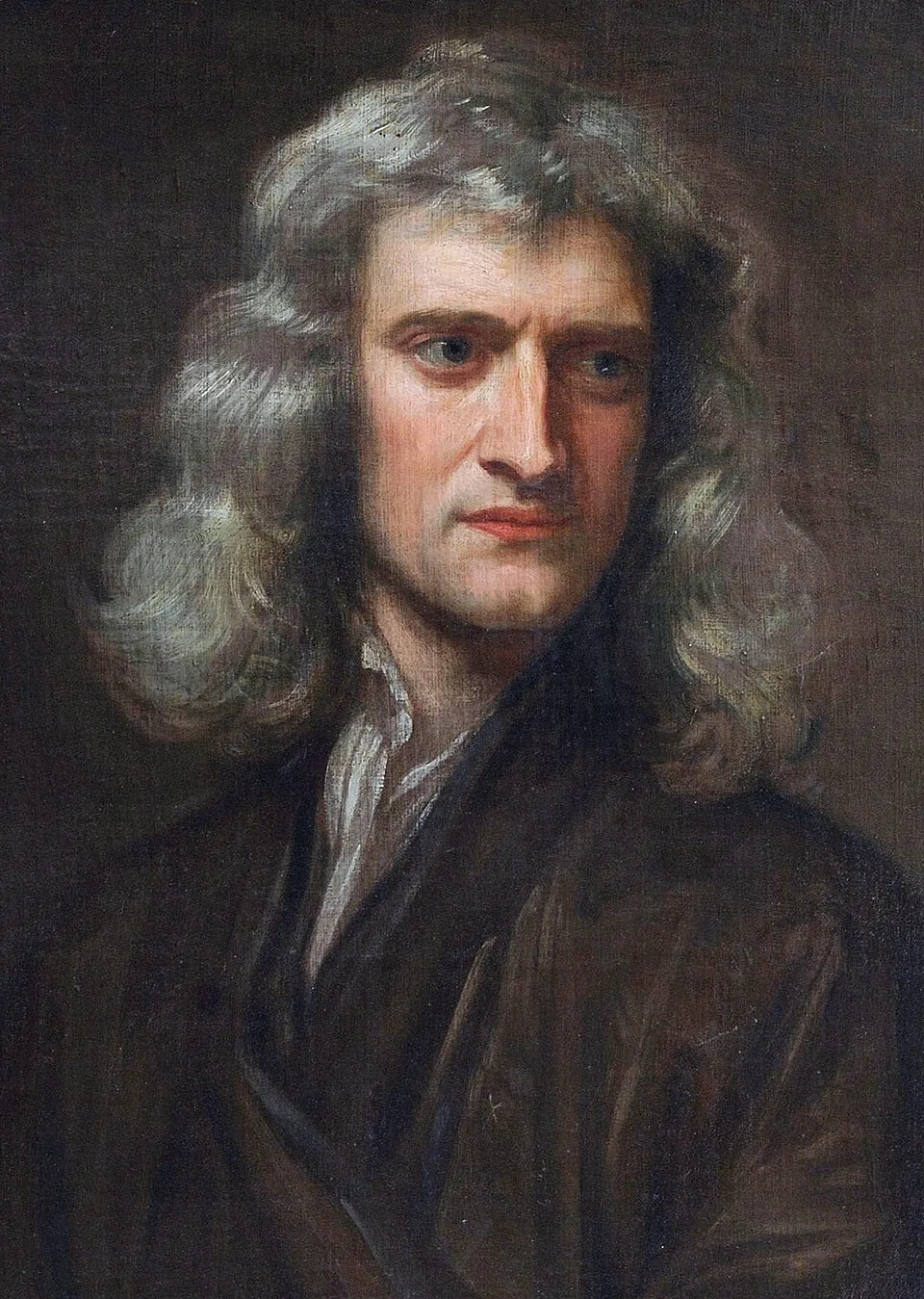
Isaac Newton
The solution that became the most famous was Newton’s. According to the famous story recorded by his niece’s husband, Newton found Bernoulli’s challenge in the mail on January 29, 1697, by which point he had already moved away from doing much mathematical work and had settled into a new position working at the Royal Mint in London. Although the rest of Europe’s best mathematicians had been given months, Newton solved the problem in a single day.
Newton was not flattered by the challenge, however, complaining that he did not love “to be dunned and teased by foreigners about mathematical things,” sending his solution to the Royal Society to be published anonymously. Newton sent a very brief solution, explaining how to construct the cycloid passing through the two points and stating it was the curve of fastest descent, but not publishing all of his calculations. His attempt at anonymity was unsuccessful, with Johann Bernoulli immediately recognizing it was his work and declaring he recognized “the lion from its claw.”
Even beyond the drama that surrounded it, the brachistochrone challenge is one of the great moments in the history of math. The problem itself was new, asking for the best possible curve to minimize time, which was quite different from just finding the best number to maximize or minimize a function. The techniques invented to answer it, especially those created by the Bernoulli brothers, were later generalized by Euler and Lagrange into the calculus of variations, a field that went on to reshape physics, with principles similar to the one behind the brachistochrone being applicable to optics, classical mechanics, and even quantum theory. In posing the problem, Bernoulli had written that the solution “will bestow fame and remain as a lasting monument,” and he turned out to be correct.