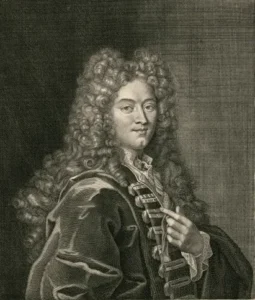
If somebody paid you to publish your discoveries under their name, would you take the deal? It might sound like a random hypothetical, but this exact situation happened in the late 1600s, between two famous mathematicians: Guillaume de L’Hôpital and Johann Bernoulli. The result of their arrangement was an incredibly useful tool in calculus, one that almost every calculus student learns today. It’s called L’Hôpital’s rule, but in reality, it was discovered by Johann Bernoulli, making it one of the only theorems in math named after someone only because he paid for it.
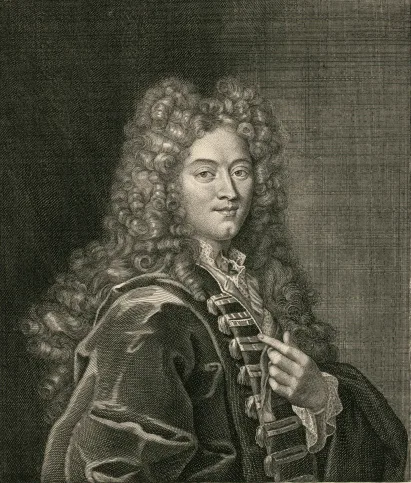
Guillaume de L’Hôpital
Guillaume de L’Hôpital was a French nobleman born in Paris in 1661, into a family with a long history of military service. L’Hôpital began his career as a cavalry officer, but due to his nearsightedness, he was forced to leave the army. As a result, he turned his focus to math, a topic he had been interested in since childhood, fully devoting himself to it.
L’Hôpital became one of the most important French mathematicians of his generation. He was a member of the French Academy of Sciences and solved the famous brachistochrone problem, a challenge also solved by Newton, Leibniz, and Jacob and Johann Bernoulli. Most importantly, in 1696, he published the Analyse des Infiniment Petits pour l’Intelligence des Lignes Courbes (Analysis of the Infinitely Small for the Understanding of Curved Lines), the first ever textbook on Leibniz’s differential calculus. This textbook is also where L’Hôpital’s Rule first appeared in print.
Crucially for our story, L’Hôpital was also very wealthy. While he made significant mathematical contributions, he was never a professional mathematician in the sense of earning his living from it, since he was a marquis with the resources to spend his time and money on mathematics. This wealth is exactly what made his arrangement with Bernoulli possible.
A quick note on the spelling of his name: you may have seen the name written as both L’Hôpital’s rule and L’Hospital’s rule. Both spellings refer to the same person, and while you might assume that the latter is simply an incorrect spelling, both are technically correct. L’Hospital reflects the older French spelling that was used in his lifetime, while L’Hôpital is the modernized form, with the accent replacing the silent “s”. The modern spelling, which is more common today, will be used in this article, but the older one is still in use, including by the College Board in AP Calculus.
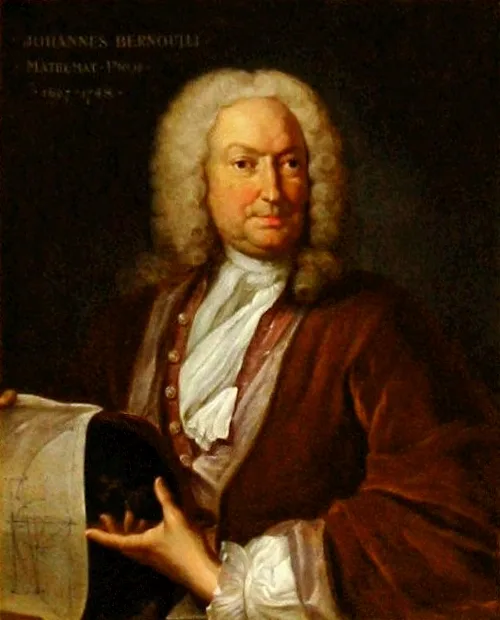
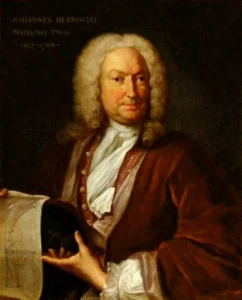
Johann Bernoulli
Johann Bernoulli, born in Basel, Switzerland, in 1667, was a member of one of the biggest mathematical families in history. The Bernoullis produced eight prominent mathematicians, most famously Johann’s older brother Jacob, known for Bernoulli numbers, and Johann’s son Daniel, known for Bernoulli’s principle in physics. Johann himself was also an important mathematician, a master of Leibniz’s new calculus who made major contributions to differential equations, the calculus of variations, and much more. He also later became the teacher of a young Leonhard Euler.
Bernoulli was a brilliant mathematician, but also famously combative. He spent years in bitter priority disputes, including with his own brother Jacob and his own son Daniel, both of whom he accused of stealing ideas. This reputation became important after his deal with L’Hôpital, where his reputation for disputes led many at the time to be skeptical of his claim to L’Hôpital’s rule.
Early in his career, Bernoulli had a major problem: money. Unlike L’Hôpital, he wasn’t a wealthy nobleman, and in the early 1690s, he had yet to obtain a stable academic position. So, when L’Hôpital offered to pay him for his mathematical discoveries, it was hard for him to refuse.
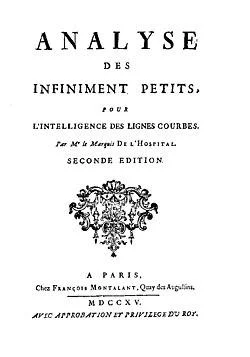
Title page of L’Hôpital’s Analyse des Infiniment Petits (second edition, 1715)
Bernoulli first met L’Hôpital in Paris in 1691, where Bernoulli agreed to tutor L’Hôpital in calculus. Then, in 1694, L’Hôpital made Bernoulli an incredible offer, paying him a salary of 300 livres (~$30,000 today) in exchange for his newest mathematical discoveries. Crucially, he would only send them to L’Hôpital, never publishing or sharing his work. L’Hôpital was clear on this point, writing in his initial offer that Bernoulli would “communicate to me your discoveries, at the same time asking you not to disclose any of them to others. I ask you even not to send here to Mr. Varignon or to others any copies of the writings you have left with me; if they are published, I will not be at all pleased.”
Bernoulli quickly accepted the deal, and the results of the arrangement appeared two years later in L’Hôpital’s Analyse des Infiniment Petits. The first published textbook on differential calculus, the textbook was excellent and incredibly influential. However, much of its content was built on Bernoulli’s work, including a rule for evaluating limits of the indeterminate form $\frac{0}{0}$, now known as L’Hôpital’s Rule. The book’s preface did thank the Bernoulli brothers and Leibniz in general terms, saying L’Hôpital had made free use of their discoveries, but nothing in it indicated that L’Hôpital’s rule was actually Bernoulli’s discovery.
Interestingly, Bernoulli publicly praised the book when it came out, most likely because he intended to honor the agreement he signed. It was only after L’Hôpital died in 1704 that Bernoulli began openly claiming the rule and much of the book’s content as his own. Given his reputation for priority disputes and a general acknowledgment of L’Hôpital’s talent, few believed him at the time. However, this time, he was telling the truth. In the early 1900s, when Bernoulli’s original lecture notes were discovered, it became clear that L’Hôpital’s textbook mirrored his notes, and that Bernoulli had indeed been the person to discover the rule. Later, in the 1950s, his correspondence with L’Hôpital was discovered, and the terms of the deal came to light. By then, though, it was far too late. The rule had been published first in L’Hôpital’s textbook, under L’Hôpital’s name, and to this day, it remains L’Hôpital’s rule.
It wouldn’t be very surprising if you’ve heard of other misattributions of mathematical discoveries in the past. Math is actually full of things named after the wrong person. The Pythagorean theorem was known to Babylonian mathematicians over a thousand years before Pythagoras. Pascal’s triangle was studied in India, Persia, and China centuries before Pascal, and is still known as Yang Hui’s triangle in China. Pell’s equation was named after John Pell, who actually had almost nothing to do with it, only because Euler accidentally misattributed it to him instead of William Brouncker, who actually solved the problem. Many other examples exist, since things very often end up named after the person who popularized them or used them most visibly, not the person who discovered them first.
Even among all of these, L’Hôpital’s rule remains a special case. Typically, misattribution happens through confusion, misunderstanding, or someone stepping in to take credit and nobody arguing otherwise. In this case, there was no confusion at all. L’Hôpital literally paid Bernoulli for his work and contractually required him not to publish it himself. It’s one of the only cases in the history of math where a theorem is named for the wrong person because the person it’s named after bought the theorem.
So, where does that leave us? Today, most historians agree that the rule was Bernoulli’s discovery, and some textbooks even mention the story. However, it would be unfair to remember L’Hôpital as only a rich man who bought his discoveries, as he was a genuinely talented mathematician whose textbook taught a generation of Europeans about calculus. You might also wonder why the rule isn’t renamed for Bernoulli to correct the injustice. While it seems like a nice gesture, if we were to rename everything in math that’s misattributed, almost none of the names we know today would stay the same, creating many more problems than it would solve.
As for Bernoulli, he seems to have regretted the sale as soon as its consequences became clear, resenting that L’Hôpital received all the credit and praise for a discovery that was actually his. Even after spending his later years insisting the rule was his, he still failed to get it back. The deal was made and upheld, with L’Hôpital paying Bernoulli as promised, but Bernoulli was clearly unhappy with the consequences. Perhaps that’s a lesson to be learned from his story: make sure that you’re actually willing to part with what you sell.